


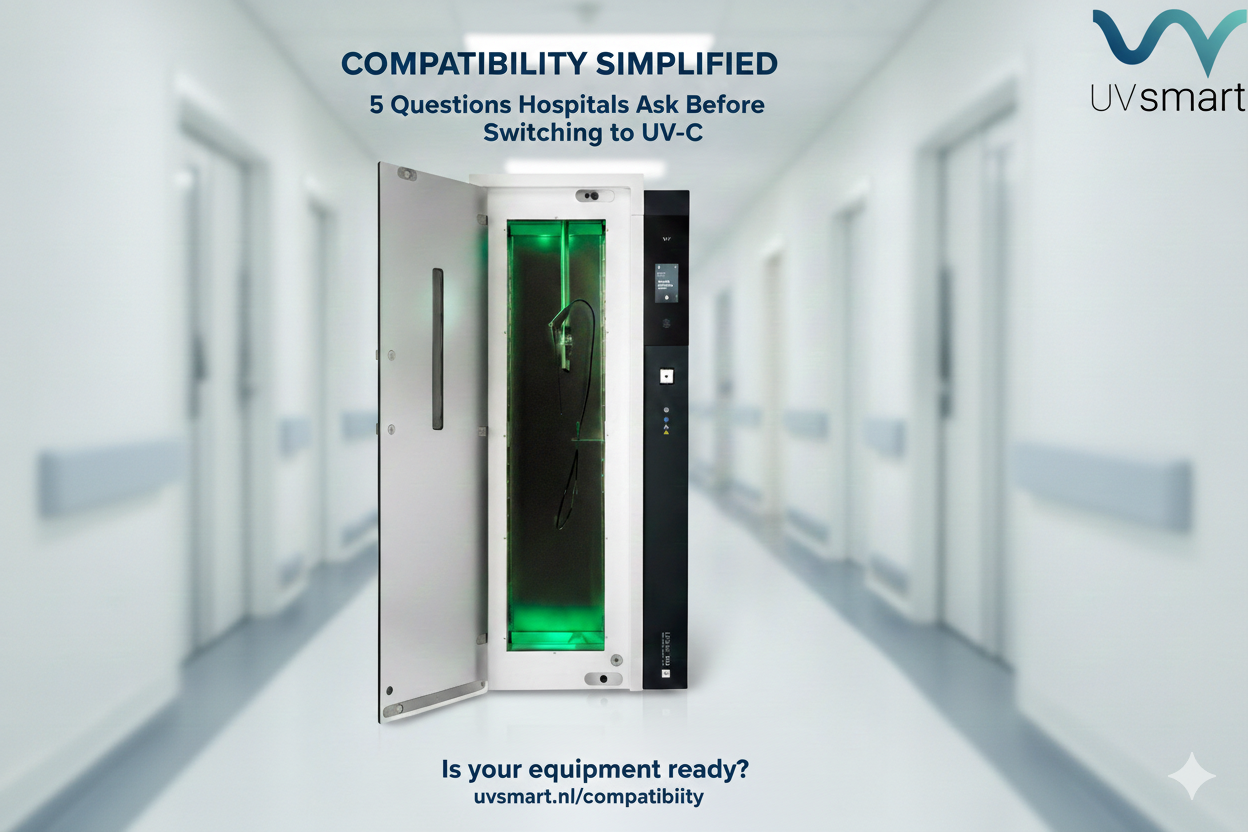
Before implementing UV-C disinfection in a clinical environment, one question always comes first:
Is it compatible with our equipment?
For hospitals, compatibility isn’t a “technical detail.” It impacts workflow reliability, device integrity, and ultimately patient safety, especially for semi-critical devices such as invasive ultrasound probes, ENT endoscopes, and TEE probes.
To help teams evaluate UV-C disinfection properly, here are the 5 most common compatibility questions hospitals ask (and what to do next).
Quick answer: where to check UV Smart compatibility
If you're short on time, start here:
This is the fastest way to confirm your exact manufacturer and device model.
1) What does “compatibility” mean in UV-C disinfection?
In healthcare reprocessing, compatibility means far more than “does it fit in the device.”
When hospitals talk about compatibility, they’re typically evaluating whether a specific probe/scope can be safely processed under UV-C workflows without:
- damaging the device materials
- leaving any area insufficiently disinfected due to geometry
- creating reprocessing gaps that reduce compliance or repeatability
This is why UV Smart’s approach to compatibility is not generic or assumption-based, it’s model-specific.
Best practice: confirm your device in the UV Smart compatibility check before implementing protocols.
2) Is the UV Smart D45 or D60 compatible with my equipment?
This is one of the most common questions and it’s also where hospitals lose time if compatibility is unclear.
Equipment can vary significantly by:
- device geometry (probe head or scope design)
- material finishes/coatings
- connector shape and thickness design
- manufacturer-specific requirements
That’s why UV Smart provides a dedicated tool to verify your probe model:
If your department is disinfecting devices daily in high-throughput workflows, pairing the compatibility check with a validated approach matters. For background and implementation best practices, see the UV-C HLD FAQs.
3) Why does compatibility matter so much for semi-critical devices?
Because semi-critical devices require high-level disinfection (HLD) and devices like ultrasound probes, TEE probes, and certain channel-less ENT endoscopes often fall into this category depending on use case and patient contact.
These devices require reprocessing standards that are not only infection-prevention sensitive, but also device-preservation sensitive. In other words: your workflow must be effective without damaging expensive equipment or shortening its lifespan.
If compatibility is not confirmed, hospitals risk:
- inconsistent disinfection outcomes due to design mismatch
- unnecessary repeat reprocessing cycles
- increased repair/service costs due to material wear
- delays in patient throughput caused by workflow interruptions
UV Smart supports standardized UV-C disinfection workflows for both:
- D45 (focused on ultrasound probes), and
- D60 (focused on ENT endoscopes and TEE probes)
That’s why compatibility must be paired with evidence-based performance. In a recent independent study, TU Dublin confirmed how UV Smart achieves a ≥6-log reduction (or better), reinforcing the importance of validated, repeatable HLD workflows for semi-critical devices.
And because different departments disinfect different device categories (including ENT endoscopes and TEE probes), UV Smart provides dedicated compatibility verification for both D45 and D60 workflows, so hospitals can confidently match the right system to the right equipment.
4) Can we assume compatibility if another hospital uses UV Smart with a similar tool?
Short answer: No, compatibility must be verified by exact model.
Even probes that look identical can differ in:
- generation/version
- coatings/material changes
- geometry changes that impact exposure
- statements or letters of compatibility
This is why a compatibility-first workflow beats anecdotal evidence every time.
Action step: confirm the exact manufacturer + model using the UV Smart compatibility check.
(Also: procurement teams love this, because it reduces purchasing risk.)
5) How do we check compatibility for UV Smart D45 and D60?
The easiest way is to check our directly to the right compatibility tracker based on equipment type.
For ultrasound probes
Use:
- UV Smart D45
- then verify with UV Smart D45 compatibility
For ENT endoscopes + TEE probes
Use:
- UV Smart D60
- then verify with UV Smart D60 compatibility
This makes the process fast for multiple stakeholders:
- Infection prevention gets confidence
- Clinical users get clarity
- Procurement gets risk reduction
- Finance gets fewer “surprise” service costs later
Compatibility isn’t optional, it’s the foundation of repeatable reprocessing
UV-C disinfection is increasingly becoming part of standardized disinfection discussions in Europe. But regardless of method, hospitals should never implement a workflow without ensuring the device model is supported.
We are consistently updating our compatibility page as new models come out. Should you not see your model or would like a compatibility statement, contact us and we will send you the exact information you need to begin your assessment of UV Smart's organization-changing products.

.png)
.png)


.jpg)
